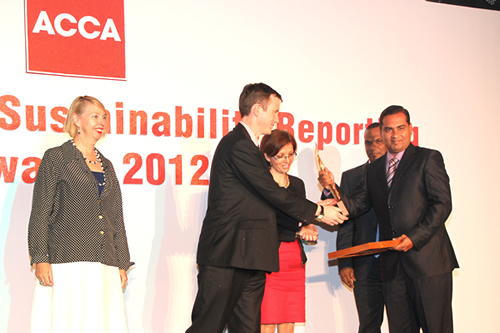
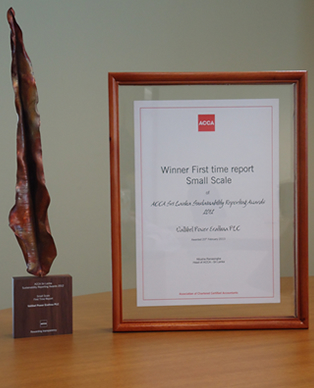
Vallibel Power Erathna PLC (VPEL) is the largest public quoted mini hydropower company in Sri Lanka controlled by entrepreneur Mr. K. D. Dhammika Perera. With three mini hydropower plants in Kuruwita, Rathnapura and Norton Bridge, the company provides a cumulative capacity of 21.85 MW. Annually the company generate and dispatch approximately 80 GWh of electricity to the Ceylon Electricity Board with reduced carbon footprint approximately 50,000 metric tons of CO2 emissions annually. Vallibel Power is another company decorated at the recent ACCA sustainability awards. Following are the excerpts of an interview with Jt. Chief Executive Officer Russell de Zilva.
Q. What is the VPEL concept on sustainability?
Russell – Concept of Sustainability of Vallibel Power Erathna PLC is based on the right balance of economic, environmental, and social considerations to business decisions. We strive for continual growth by operating within the framework of our Sustainability Principles. These are Governance, Economic Performance, Stakeholders, and Environment. These pillars are what keep VPEL sustainable!
Q. In what ways does VPEL manage these principles?
Russell – We value ethics and integrity in our business. We comply with legal requirements and assure that our economic performance drives long term success of our business. We also value our stakeholders. Our professional and ethical relationship with CEB, our employees, our community, and other external stakeholders assures the sustainability of our business. Considering our responsibility towards Environment, we are committed to provide cleaner energy generation with minimized environmental impact.
Q. How is this concept, sustainability, put into practice and what steps do you take to address sustainability?
Russell -At Vallibel Power Erathna PLC, we ensure sustainability of the business in every stage of our operation, Design and Development Stage, Construction Stage, and Electricity Generation Stage.
At the Design and Development Stage, we analyze our ability to initiate the plant in a sustainable manner. We carry out a range of assessments during the analysis process and if we detect a failure in any assessment, we would immediately discontinue the project. We ensure that we are complied with all regulatory requirements for the establishment of the project. Meeting regulatory requirements is a time consuming process, but company coordinates with Governmental Authorities for necessary approvals to initiate the project. In case of a variation to the requirements, we’d suspend the project initiation.
We cannot ignore the requirements of our community during the design and Development stage. We need to ensure that the day to day life of the community is not compromised. To do this, we analyze the impact of the project to the community of the project area including their water consumption requirements, residential requirements, occupational requirements and other requirements of their routine life that may be affected by the project implementation. We consider re- habilitation requirements and impact of such requirements to the community.
During D& D stage, we give priority to the Environment. VPEL has devised various tests to assess the impact to the environment with the project initiation. For example, to make sure the ecological system is not disturbed by our operation, we facilitate a natural flow of stream. We also assess if we endanger special habitants, endemic species, and threatened species of flora and fauna of the area. We also consider geological aspects such as landslides and damage to residences of the project area. Our analysis evaluates the rock blasting techniques and selects the most appropriate and less impacting technique, for example, chemical blasting.
Q.In most instances, things are different in actual scenario. Have you encountered such difficulties at operation?
Russell – Well, during the Construction Process, we usually encounter challenges with regard to the community, and environment. But we take all action necessary to overcome these challenges. We make sure that the project construction is carried out with minimum impact to the environment and community. We do this by assessing the impact of our machinery and vehicles to the environment and community. Examples of such impacts are noise level, dust level etc.
During construction process, VPEL takes measures such as re-planting trees, and managing waste water and other waste in the construction area to ensure sustainability. Community of the project area is always benefited with VPEL activities. During construction, we provide job opportunities to community. These individuals, who are employed, are given necessary training to develop their skill level. They are also given all facilities required in the work environment. As a Corporate Social Responsibility initiative, VPEL constructs access roads to project areas.
Q. Is there a significant role for the company to play during the generation of electricity?
Russell – Of course! Once the Mini Hydro Power Project is established, we need to continually strive to maintain a sustainable business. VPEL do this through the effective monitoring system that is in place. Our sustainability monitoring system sets goals, measure performance and manage change continually. While managing an ethical and transparent governance body, we ensure that VPEL is economically sound. VPEL always respects and values its stakeholders, both internal and external, and the company always aims at providing a better service. Periodically, we assess significant environmental aspects of the business and implement projects to minimize the impact of these significant environmental aspects. So, concept of sustainability of VPEL is an on-going process.
Interviewed by: Ashwin Hemmathagama